

In partnership with

👋 Hi, it’s Rohit Malhotra and welcome to the FREE edition of Partner Growth Newsletter, my weekly newsletter doing deep dives into the fastest-growing startups and S1 briefs. Subscribe to join readers who get Partner Growth delivered to their inbox every Wednesday morning.
One quick question: what best describes you? Tell me here. It takes 5 seconds and shapes which deals I break down next.
Latest posts
If you’re new, not yet a subscriber, or just plain missed it, here are some of our recent editions.
Partners
Stop losing deals in between meetings.

Aligned is changing how B2B teams run their most important deals.
Most reps guess where a deal really stands. They forecast on a gut feeling and the buyer’s word vs what's actually happening. Then they realize the deal slipped through only after it's too late. Aligned surfaces what buyers are actually doing inside every deal: the risks, the openings, and the exact next step to keep things moving.
Start increasing your close rates and stand up your first deal room in minutes.
Interested in sponsoring these emails? See our partnership options here.
Subscribe to the Life Self Mastery podcast, which guides you on getting funding and allowing your business to grow rocketship.
Previous guests include Guy Kawasaki, Brad Feld, James Clear, Nick Huber, Shu Nyatta and 350+ incredible guests.
Introduction
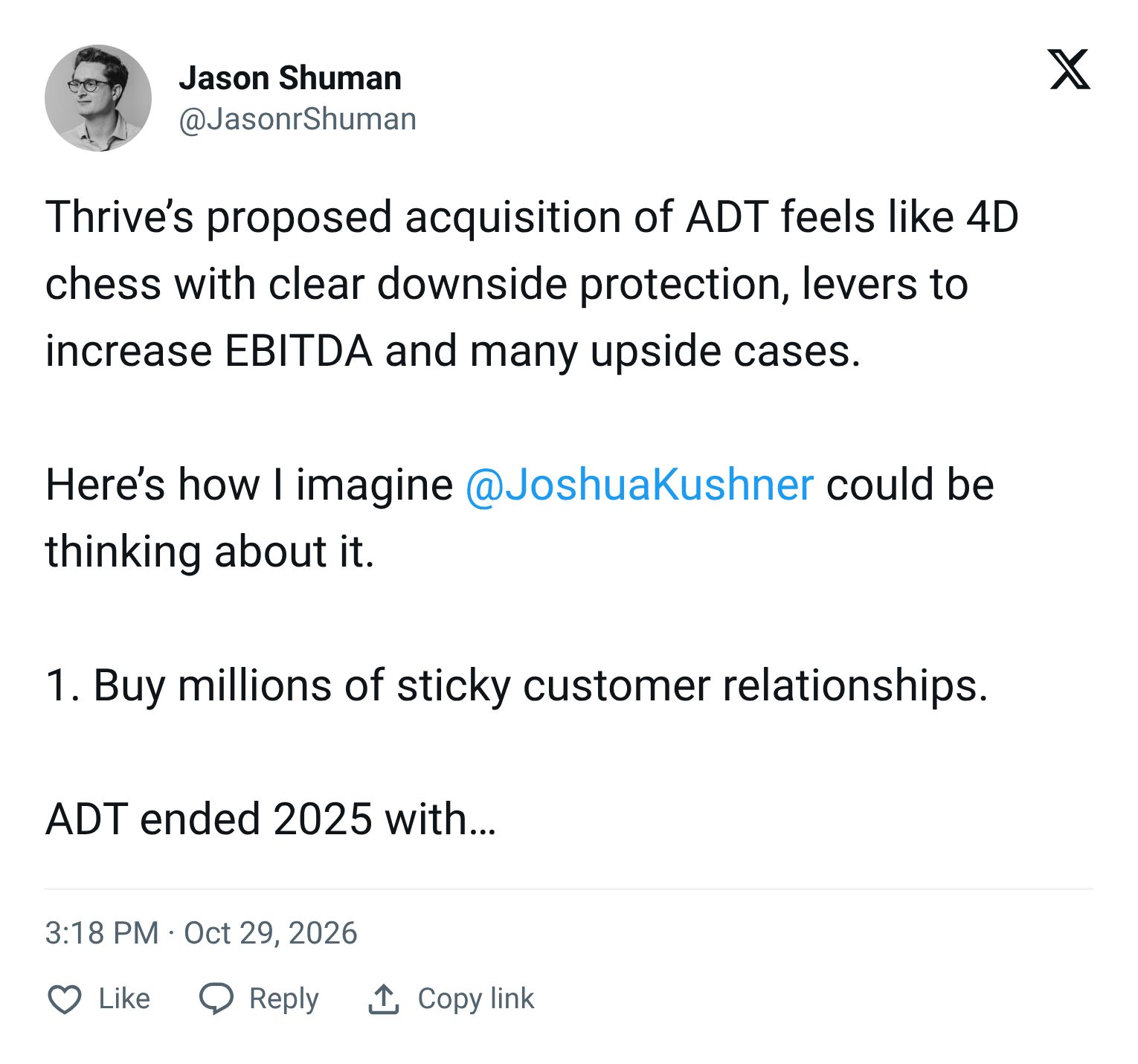
Thrive Holdings buying ADT is not a private equity take-private. It is a permanent capital owner buying a service network to rebuild with software.
$10.00 a share in cash. $15.3 billion in enterprise value. A 45.6% premium to the $6.87 unaffected close, and 52.1% above the 30-day VWAP.
Look at the gap between the two headline numbers. Equity value is $7.6 billion. Enterprise value is $15.3 billion. More than half of what Thrive is paying for is debt. Apollo funds alone provided the financing commitments, and the deal carries no financing condition.
ADT was cheap, not broken. 150 years of brand trust. 12,000+ employees. A nationwide network of professionals already inside millions of homes. The public market priced all of it as a legacy alarm business.
Thrive already owns 75+ businesses across accounting, IT services and the built environment. ADT becomes the foundation of a new smart home security vertical, with Thrive’s engineers embedded alongside the field teams.
Setup
In 1874, ADT started as American District Telegraph, wiring alarm signals across city blocks. More than 150 years later, Thrive Holdings is paying $15.3 billion for it.
The buy is not the alarm panel. It is the field network no software company can build: an installation and service footprint already inside millions of homes, ready for AI to sit on top. ADT serves more than six million customers and holds roughly one-third of the installed base for security systems.
ADT was priced as a utility the market had stopped believing in. Apollo took it private in 2016, brought it back to the NYSE in 2018, and sold its remaining stake five months ago. By October 27 it closed at $6.87.
What kept compounding is real. Q3 revenue rose 4% to $1.35 billion. Recurring monthly revenue held at $360 million. Adjusted free cash flow came in at $217 million for the quarter.
That is the asset Thrive wants. It does not buy software. It buys distribution and drops engineers into it. Thrive supplies AI models and forward-deployed engineers who work inside the companies it owns. Accounting firms brought back office. IT services brought workflow. ADT brings the front door.
The bid
Thrive is paying $10.00 a share, all cash, for ADT. That is $7.6 billion in equity and $15.3 billion in enterprise value against Q3 revenue of $1.35 billion. Annualized, roughly 2.8x revenue. Not a software multiple. The multiple of a cash machine the public market stopped rewarding.
The number that matters is the capital stack. Equity is $7.6 billion. Enterprise value is $15.3 billion. More than half of what Thrive is buying is debt. Apollo funds alone provided the financing commitments, with no financing condition. The same Apollo that took ADT private in 2016 and sold its last stake five months ago is now lending the money to take it private again.
The premium is 45.6% over the $6.87 close and 52.1% over the 30-day average. Thrive is not paying for growth. Recurring monthly revenue held at $360 million while attrition sat at 13.1% for a fourth straight quarter, 2.1 points above the 11% target. It is paying for cash. Adjusted free cash flow hit $217 million in Q3. Annualized, the equity costs under 9x.

The math
Three numbers do the explaining here.
One. Thrive is paying roughly 3.0x revenue: $15.3 billion against $5.16 billion over four quarters. At the end of September the stock traded at 0.896x sales, a level beaten only once in 35 quarter-ends since 2017. The public market priced ADT near its cheapest in nearly a decade. Yet the bid still clears under the last big precedent: NRG paid 3.3x revenue and 7.2x EBITDA for Vivint in 2022. Thrive is paying 4.88x EBITDA for the category leader. Not a scarcity premium. A value buy.
Two. Growth is not the thesis. Management expects about 2% revenue growth in 2026, and monitoring, 84.9% of revenue, fell 1% last quarter. Cash is the thesis. The deal values ADT at about 9.5x the $1.61 billion of free cash flow it produced in four quarters. On equity alone, 4.7x.
Three. ADT carried $7.69 billion of debt at the end of June, roughly half the enterprise value, with Apollo funding the deal. A modest multiple on a heavy stack.

The Structure
$10.00 a share, all cash. $15.3 billion in enterprise value. That clean number is where the structure starts.
No stock. No earnout. No financing condition. Funds managed by Apollo affiliates provided every dollar of the financing commitments. Thrive is not asking ADT shareholders to wait for the AI thesis to pay off. It takes that risk itself. That is not generosity. It signals the value gets created after delisting, away from quarterly scrutiny, where only Thrive captures it.
And this is not a harvest. Apollo already ran that play: took ADT private in 2016, relisted it in 2018, sold out five months ago. Thrive is built differently, a permanent capital vehicle designed to own companies for decades, not flip them in five years. ADT keeps its brand and its 12,000+ employees. Underneath, Thrive’s engineering teams work alongside the field professionals. The name survives. The playbook changes.
The guardrails tell the rest. A go-shop to November 28, with a 10-day extension for live bidders. A right to walk for a superior proposal. Shareholder vote and US antitrust approval. Guidance withdrawn. Data policies unchanged, with no new sharing without customer permission.
Operator case
From the operator’s seat, this is not an AI bet. It is a cost-to-serve bet.
ADT already has the hard part. More than six million customers. Roughly one-third of the installed base. Share of recent buyers up from 21% to 26% in three years. Distribution is solved. The leak is retention.
The signal is in the attrition line. Gross revenue attrition sat at 13.1% for a fourth straight quarter, 2.1 points above the 11% target. Nonpay cancellations ran elevated even as voluntary disconnects fell. Customers like the service. The operation loses them anyway.
That is exactly the work forward-deployed engineers are built for. Thrive puts AI models and technical staff inside the companies it owns. ADT already started: AI-enabled customer service, Unusual Activity Alerts in ADT+, Origin AI presence sensing in pilot. Thrive is not buying a fix. It is buying a roadmap that needed patient capital.
And the front end keeps working. Installation revenue rose 32% to $265 million. Revenue payback held at 2.3 years.
The arithmetic: $360 million of monthly recurring revenue is $4.32 billion a year. Every point of attrition recovered keeps roughly $43 million. Close the gap to target and that is about $91 million of annual recurring revenue, before a single new customer.
The Bet
Thrive is wagering on four things being true at once.
One. AI fixes the operating economics. ADT does not have a demand problem. It has a retention and cost-to-serve problem, with attrition stuck at 13.1% against an 11% target. Thrive is betting its models and forward-deployed engineers can close that gap faster inside a private company than ADT could inside a public one.
Two. Patience is worth a premium. At the end of September the market priced ADT at 0.896x sales, near its cheapest since 2017. Thrive is betting a decade-long owner can invest through the quarters a public board could not, and that the market’s discount was about time horizon, not the business.
Three. The cash carries the stack. Roughly half the $15.3 billion is debt, financed by Apollo. Growth is guided at about 2%. The bet is that $1.61 billion of trailing free cash flow services the debt while the rebuild happens underneath it.
Four. The holding company is the new exit. Thrive already owns 75+ businesses across accounting, IT services and the built environment. Thrive is betting AI-enabled ownership of old-economy operators beats both the IPO and the PE flip. ADT is not the end of the run. It is the template, at scale.
Who Loses
IPO buyers lose first. ADT relisted in January 2018 at $14, already cut from a $17 to $19 range. The deal pays $10.00. Even with a 45.6% premium, anyone who bought the offering exits nearly 29% underwater almost nine years later, before dividends. Back then, investors worried about ADT’s ability to keep customers. The deal is priced on that same worry.
The dealer channel loses next. ADT’s Q3 already showed lower volume from dealers and bulk account purchases while direct professional installs improved. A buyer embedding engineers into its own field teams has little reason to prioritise third parties selling its accounts.
Google loses its neutral ground. It took roughly 6% of ADT in 2020, built ADT Self Setup on Nest hardware, and has been hosting ADT’s systems on Google Cloud. That partner now belongs to a holding company with OpenAI behind it, which supplies its own models and engineers.
And the independents lose their buyer. NRG already absorbed Vivint in 2022. The largest platform in the category now sits with an owner that never has to sell. Every remaining regional monitoring player pitches against ADT’s one-third share of the installed base, backed by AI and decades of patience, with one fewer exit.

Bigger Signal
Three threads worth pulling.
One. AI is moving from selling software to owning the businesses that use it. Thrive Holdings already counts 75+ companies across accounting, IT services and the built environment, and OpenAI holds an ownership interest in it in exchange for a dedicated research team. ADT is the largest proof point yet. The signal isn’t home security. It is that AI value may be captured by owning the operator rather than licensing to it. Watch which other venture firms build holding companies.
Two. Private credit is replacing the exit. Apollo once owned ADT outright and took it public. This time it simply lends, with debt making up roughly half of the $15.3 billion. The public market priced ADT at under 1x sales. A patient owner with borrowed money paid 3.0x. Watch which cash-rich, slow-growth public services companies stop waiting for a rerating and start taking calls.
Three. Distribution is the scarce asset in AI. Models are getting cheaper. Six million customers, an installed base of roughly one-third of the market, and technicians who walk through front doors are not. ADT paid $170 million for Origin AI this year. Thrive paid $15.3 billion for the network to run it on. Watch which AI companies buy the van, not the model.
Closing thoughts
The bull case. Thrive bought the category leader at a value price: more than six million customers, roughly one-third of the installed base and $1.61 billion of trailing free cash flow, for about 3.0x revenue and 4.88x EBITDA. That is below what NRG paid for Vivint. Drop forward-deployed engineers into the retention problem and the cash funds the rebuild.
The bear case. Half the price is debt, growth is guided at about 2%, and attrition has sat at 13.1% for four straight quarters. Investors flagged retention at the 2018 IPO. Eight years later it is still the problem. Thrive and ADT have not yet named a single new AI product.
What to watch: the go-shop closes November 28, then the attrition line. If it moves toward the 11% target, the price was cheap. If it holds at 13%, the debt does the talking, and the next AI-led take-private gets priced before it happens.

Here is my interview with Marcus Dantus, founder and chairman of Startup Mexico and a Shark on Shark Tank Mexico for 14 seasons. He built Mexico's first internet portal, founded Wayra Mexico, and has backed 30+ startups.
If you enjoyed our analysis, we’d very much appreciate you sharing with a friend.
Tweets of the week

Here are the options I have for us to work together. If any of them are interesting to you - hit me up!
Sponsor this newsletter: Reach thousands of tech leaders
Upgrade your subscription: Read subscriber-only posts and get access to our community
Buy my NEW course: Buy my course on outbound sales
And that’s it from me. See you next week.

