

In partnership with

Nobody's coming to approve your idea

People assume that real businesses get built by other people with more resources. It's how great ideas get stuck in notes apps and conversations.
But you don't need six months and a developer's salary to validate your concept. You just need a weekend. Describe what you want to exist and Lovable builds it: a real site, a real product, ready to accept real payments from real customers. Not a mockup to show people. An actual thing they can use.
You don't need anyone's sign-off to get started. Take $5 off your first month.
Discount of $5 applies to first month of any paid plan. You need to sign up via this webpage in order to claim the discount. The discount applies to new and returning users without an active paid plan. Terms apply.
Latest posts
If you’re new, not yet a subscriber, or just plain missed it, here are some of our recent editions.
Partners
Interested in sponsoring these emails? See our partnership options here.
Subscribe to the Life Self Mastery podcast, which guides you on getting funding and allowing your business to grow rocketship.
Previous guests include Guy Kawasaki, Brad Feld, James Clear, Nick Huber, Shu Nyatta and 350+ incredible guests.
One quick question: what best describes you? Tell me here. It takes 5 seconds and shapes which deals I break down next.
S1 Deep Dive
Anthropic in one minute
Anthropic files to list on the Nasdaq under ANT. Price range blank, with a reported $100 billion raise near a $2 trillion valuation, up from $965 billion. First-half revenue of $16.29 billion, up 14x. Q2 operating income of $974 million, its only profitable quarter. Net loss of $80.75 billion, $72.4 billion from convertible notes marked up. Operating cash flow of positive $3.9 billion.
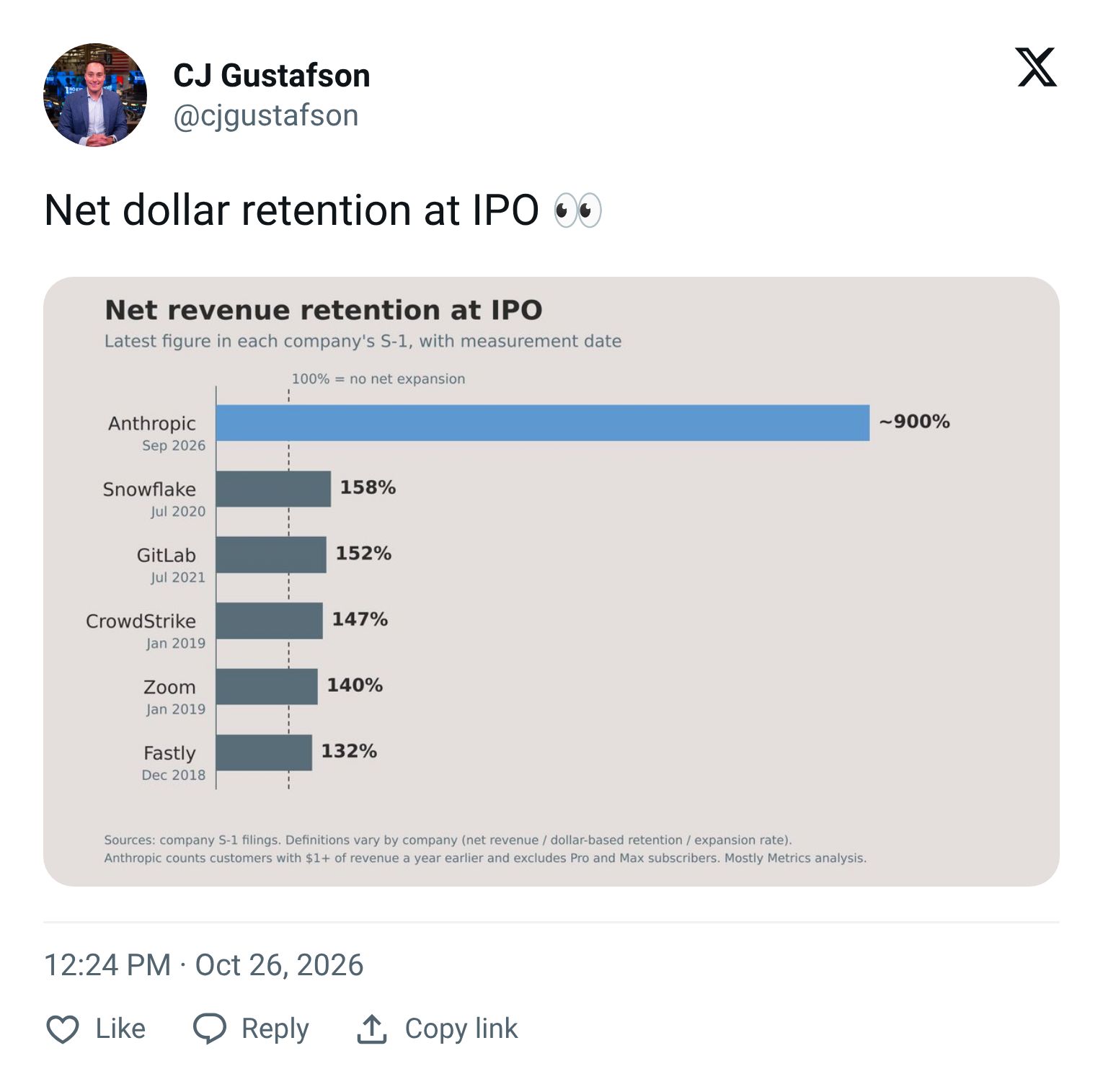
It is not a chatbot company. It is a metered intelligence utility, 80% consumption. Net revenue retention near 900%; Snowflake filed at 158%. 11,900 customers pay over $100,000. 48% of revenue runs through AWS, Google and Azure, also investors and competitors.
The fine print: $637 billion of compute commitments, mostly non-cancelable, against usage revenue with no lock-in. Q3 revenue is blank. $23.7 billion of stock comp lands after the IPO. One founder share carries 50.1% of the vote. Public buyers get the economics. Not the steering wheel.

Introduction
A company that booked $41 million of revenue three years ago filed this week to list on the Nasdaq at a reported valuation near $2 trillion.
Anthropic is a model company. It trains Claude, rents compute from Amazon, Google and Microsoft, and sells intelligence by the token. More than 11,900 customers pay it over $100,000 a year. The company would like you to see something larger, opening its filing with “for the first time in history, intelligence is something humans can build.”

Here is what it actually is. Revenue of $16.29 billion for the first half, up from $1.16 billion, with 80% metered on usage. Start with retention. Net revenue retention is about 900%, because customers who spent a dollar a year ago now spend about nine. Then the cost. Compute fell from $2.51 per dollar of revenue in Q1 2025 to $0.48 in Q2 2026, which is why Q2 printed $974 million of operating income. The efficiency is the margin. The commitments are the risk.

The net loss was $80.75 billion, and $72.4 billion of it came from convertible notes rising in value. Amazon and Google invested in Anthropic, sell it compute, resell Claude on their clouds, and compete with it on the same shelf.
History
Anthropic began as a departure. In 2021, seven researchers left OpenAI, led by siblings Dario and Daniela Amodei, convinced the field was building something powerful faster than it was learning to control it.
They set up as a public benefit corporation and spent the first two years mostly on research. Claude reached customers in March 2023. That year Anthropic booked $41 million of revenue.
Early money came with strings. FTX put in about $500 million before it collapsed. Amazon and Google followed with billions, much of it flowing back to them as compute spend. The investors were also the landlords.
Then the product found its customer: developers. Claude Code launched in early 2025, coding became the first job AI did well enough to pay for, and revenue went from $386 million in 2024 to $4.59 billion in 2025. When Opus 4.5 shipped in November 2025, quarterly growth jumped from 48% to 132%. Headcount went from about 940 to about 5,300.

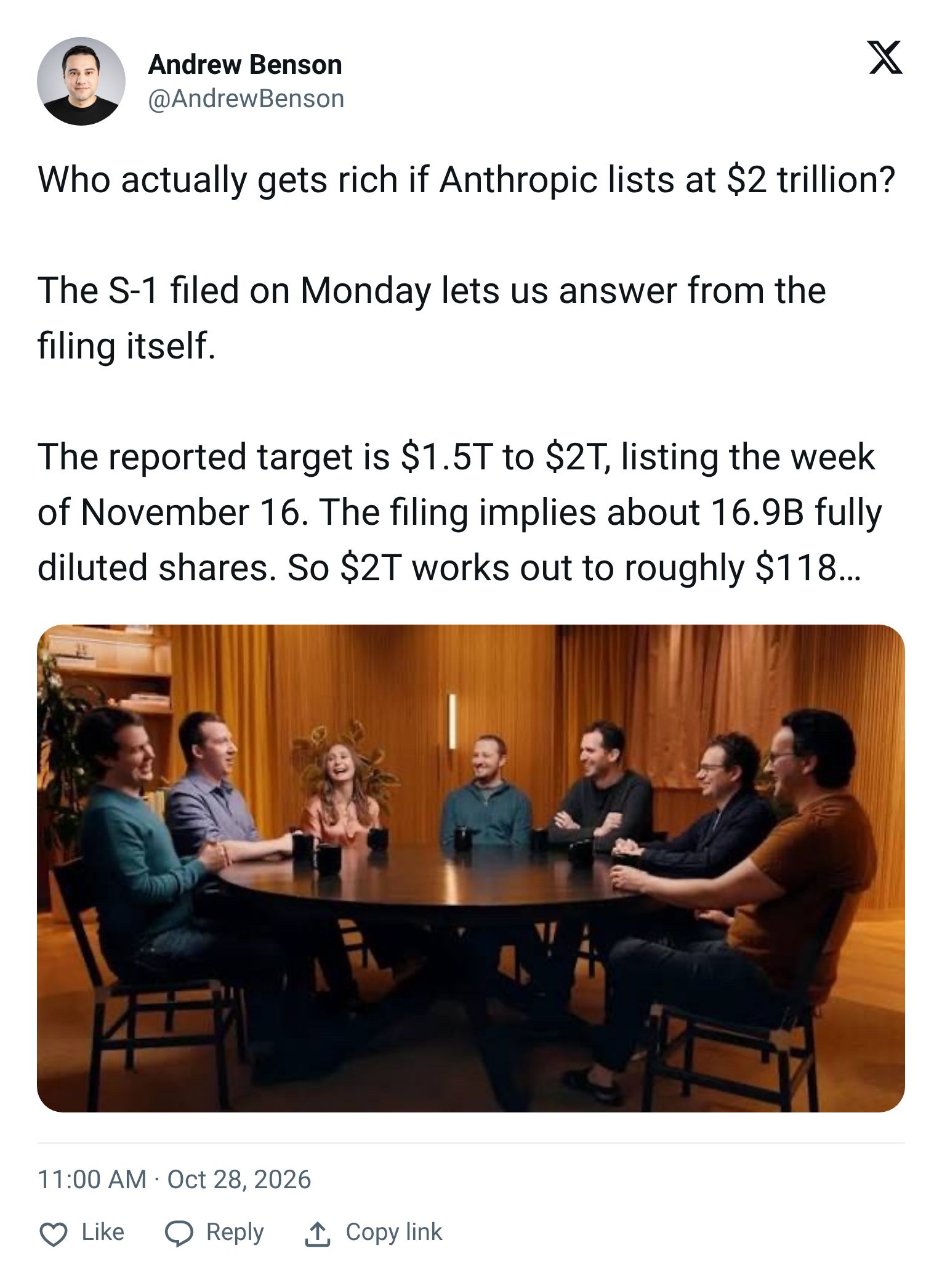
In June 2026, a $65 billion Series H valued the company at $965 billion. In October, it filed.
Risk factors
Anthropic commits to compute years ahead under take-or-pay contracts, with payments running to 2045. The total is blank. Its revenue is mostly consumption-based and mostly uncontracted. Customers can cut spend in a quarter. Anthropic cannot.
The forecasting has missed before. The filing says it significantly underestimated compute needs in the past, and has asked cloud partners for more than they were willing to give. Those partners also build competing models. Agentic workloads make it harder, consuming far more compute per interaction than chat, so costs could rise faster than revenue.
Then the chain reaction. A default on certain commercial agreements could trigger cross-defaults on the credit facility and convertible notes, accelerating debt and cutting off data center access. Some financing also locks Anthropic into specific chip suppliers, even if better hardware arrives.
The strangest risk is self-made. Claude now helps build the next Claude, which the company calls “closing the loop.” A flaw in one model could carry into the next, and capabilities could outrun safety work. Anthropic has already delayed releases, as with Mythos. That restraint is not a footnote. It is a cost competitors may not pay.

Market Opportunity
Every S-1 sells a market. Anthropic’s most useful number is not a market size. It is a share of wallet: 0.1%.
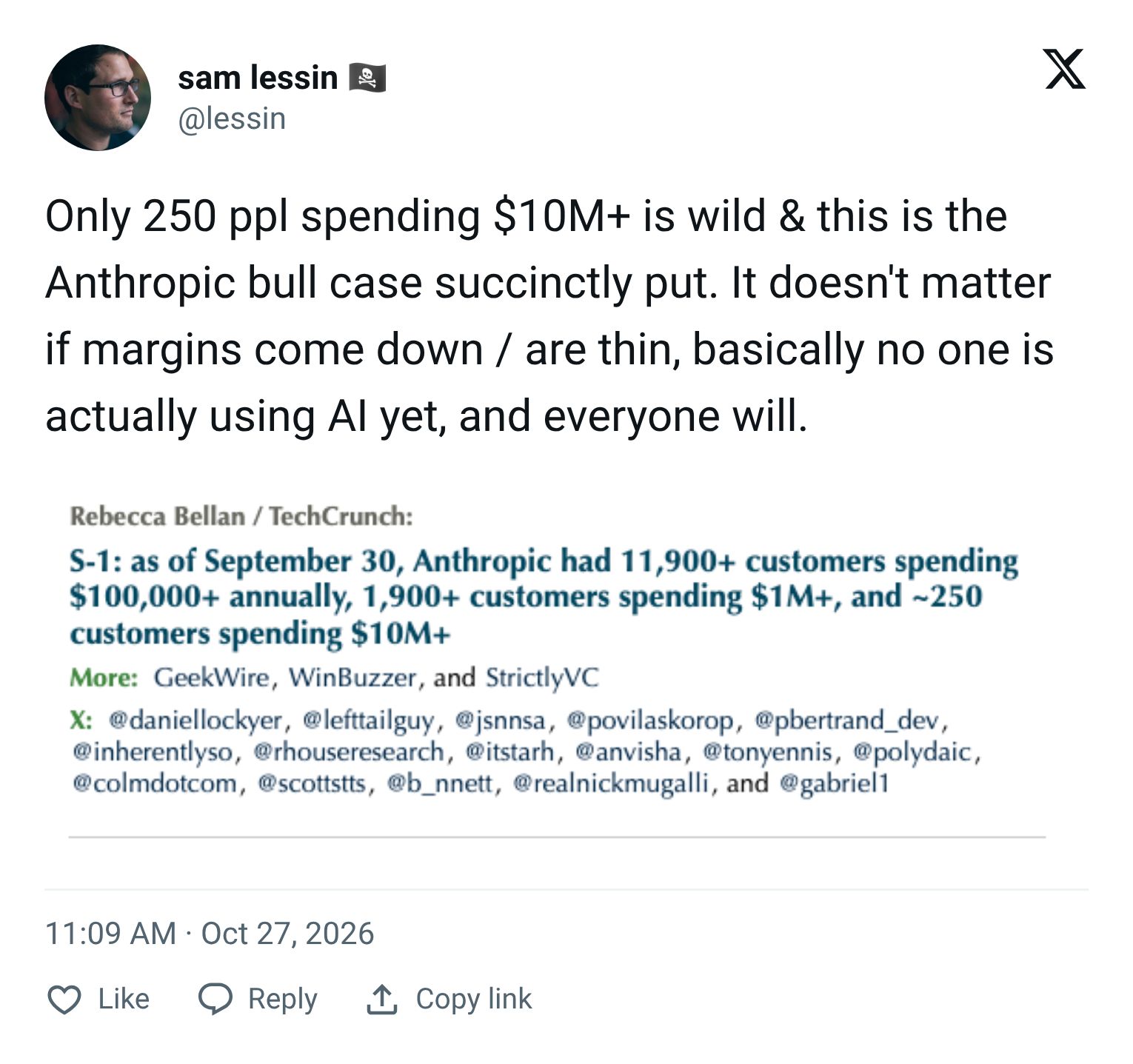
More than half the Fortune 500 already spend $100,000 or more a year with Anthropic. On average, that spend is less than 0.1% of those companies’ total expenses. Even the top 10 Fortune 500 customers spend under 1%. The pitch is not that the market is big. It is that the market has barely started paying.

The bet underneath is that cheaper intelligence creates more demand, not less. Opus 5.5 cut cost per task by about 40% versus Opus 5. When Opus 4.5 did something similar in November 2025, quarterly growth went from 48% to 132%. Lower price. Higher bill.

Distribution is built for reach. Claude sells inside AWS, Google Cloud and Azure. Accenture, Deloitte, KPMG and PwC run Claude practices. Salesforce and Snowflake embed it. Ode, built with private equity firms, pushes it into mid-sized portfolio companies. Legal, healthcare and financial services are the next edges.
Product
Most people meet Anthropic through a chat window. That window is the smallest part of what it sells.

The real product is intelligence on a meter. Every request is priced by model and billed by the token, and the company is built around getting customers to send more of them.
There are four model families, each tuned to a different trade between capability, cost and speed. Mythos and Opus take the hard work: coding, agents, long research tasks. Sonnet handles the middle. Haiku clears cheap, fast volume. Customers mix and match, sending each task to the least expensive model that gets it right. Underneath, one shared compute pool runs across Trainium, TPUs, Nvidia and AMD.
Two revenue engines run off that pool. Usage, sold through the API, Claude Code and the three big clouds, brings in 80%. Subscriptions bring in the rest, and they feed usage: once a team outgrows its plan, it upgrades or starts paying per token.

Nothing stays new for long. Anthropic shipped 250 models, features and products in nine months, and releases from the prior six months drove over 80% of Q3 revenue. It has also committed to keeping Claude free of ads.
Anthropic is not selling software. It is selling a utility bill that customers want to grow.
Business Model
Anthropic gets paid in two ways, and one of them matters far more than the other.
Usage brought in $13.1 billion in the first half, 80% of revenue. Subscriptions brought in $3.2 billion. Larger enterprises increasingly sign annual or multi-year deals with minimum spend in exchange for locked pricing, but even those mostly land as usage revenue. The model rewards consumption, so revenue rises every time a customer finds a new job for Claude.

The catch is that consumption cuts both ways. Spend fell about 20% over the two weeks ending January 2, as developers paused for the holidays. Revenue moves with behavior, not contracts.
Nearly half of it, 48%, flows through AWS, Google Cloud and Azure. Anthropic keeps the customer relationship and pays each cloud a cut, and it books those sales gross. Sales, marketing and partnerships came to 19% of revenue, mostly channel fees.

That shapes the margin. Backed out of the footnotes, gross margin was about 85% in the first half. Load in partner fees and free-tier compute, and it is closer to the low 60s.
Compute is the swing factor. It fell from 201% of revenue to 55% in a year. But it is bought 12 to 18 months ahead. Revenue flexes. The bill does not.
Management Team:
Dario Amodei, Co-Founder, Chief Executive Officer and Director

Amodei is a scientist, not a salesman. He holds a Ph.D. in Biophysics from Princeton, did a postdoc at Stanford’s medical school, and worked at Google Brain before leading research at OpenAI. The résumé is papers and scaling laws. Which fits, because Anthropic’s whole bet is that more compute keeps buying better models. He has exactly one direct report.
Daniela Amodei, Co-Founder, President and Chairperson
Daniela runs the company. The rest of the executive team reports to her, and she oversees day-to-day operations. Dario sets the direction. She makes it ship. She is 39.
Krishna Rao, Chief Financial Officer
Rao has done this before, from the inside. At Airbnb he ran corporate FP&A and later global corporate development, helping raise more than $10 billion including the IPO. He was CFO at Fanatics Commerce and Cedar before joining Anthropic in May 2024.
Investment
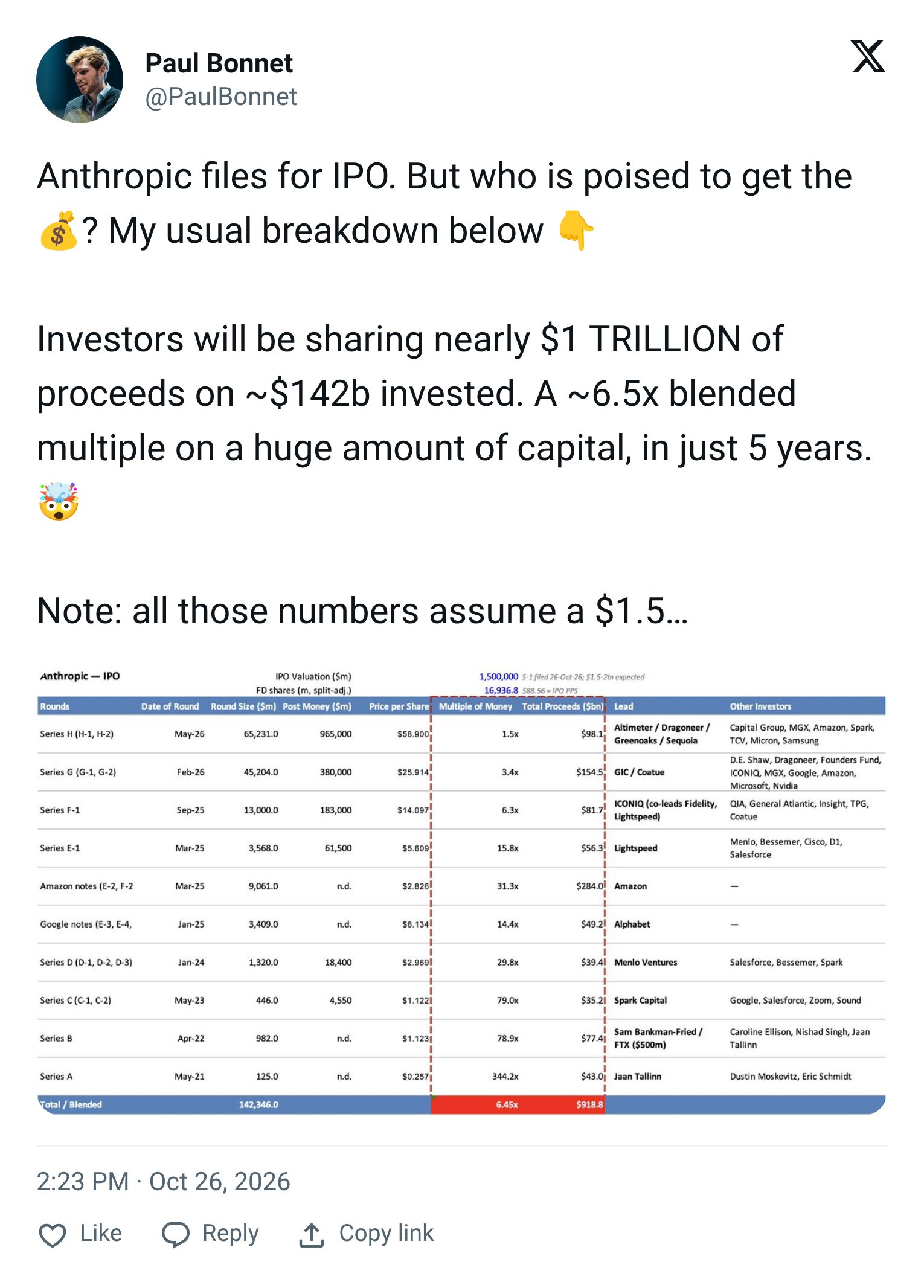
Anthropic has raised $141.1 billion to date. Most companies raise money to build a product. Anthropic raises money to buy compute, and much of it comes from the companies selling the compute.
The last private round was a $65 billion Series H that closed in June, led by Altimeter Capital, Dragoneer, Greenoaks and Sequoia at a $965 billion post-money valuation. Financial investors bring the price. Strategic investors bring the chips.
Amazon holds $6.2 billion of convertible notes, the company’s only outstanding debt, which turn into non-voting Class N shares at the IPO. Google’s stake is capped at 14.99%, with an option to buy up to $10 billion of stock at the IPO price. Strategic holders sit mostly in Class N: economics without a vote.
Behind that sits about $77 billion of undrawn financing from the same names. Google up to $20 billion through 2030, tied to compute deals and revenue targets. Amazon up to $15 billion. Broadcom up to $42 billion to fund a chip lease. A $15 billion revolver is untouched.
The money is not passive. It loops. Investors fund Anthropic, Anthropic pays them for compute, and they resell Claude to their own customers.
The IPO could add $100 billion more. It lands on $131.7 billion already in the bank.
Competition
Anthropic competes on three fronts at once, and the filing is candid that it does not control any of them.
The first is the other labs. OpenAI is the obvious rival, and the gap shows in growth: Anthropic’s 2025 revenue grew 11.9x against a press-reported 253% for OpenAI. But leads in this market are rented, not owned. The filing warns that models one or two versions behind the frontier lose commercial value fast, and models under six months old drove over 80% of Q3 revenue. Fall behind for a quarter and customers move.
The second is its own partners. Amazon, Google and Microsoft sell their own models on the same clouds that resell Claude, and they can see Anthropic’s pricing and terms. They are also its compute suppliers, which means a competitor decides part of its capacity.
The third is price. Open-weight models offer adequate performance at lower cost, and well-capitalized rivals can outbid Anthropic for scarce chips.
Then there is the competitor inside the revenue line. Between 5% and 7% of revenue came from customers violating its terms, much of it reportedly rivals distilling Claude to train their own models.
Anthropic is not defending a moat. It is defending a lead, one release at a time.
Financials
Revenue was $16.3 billion in the first half, up from $1.2 billion a year earlier. Q2 alone was $11.6 billion, up 144% on Q1. Q3 is blank.

The cost curve is the real story. Compute and infrastructure was $8.9 billion in the half, 55% of revenue, down from 201% a year earlier. In Q2, revenue grew 1,368% while compute grew 300%. Backed out of the footnotes, gross margin was about 85%, up from 40% in 2025 and negative 95% in 2024. Fully loaded with partner fees and free-tier compute, it is lower.
Q2 produced $974 million of operating income, an 8% margin, and the only profitable quarter in the filing. The first half was still a $693 million operating loss. Adjusted, Q2 ran at 19%.

The headline loss is not a cash loss. The net loss was $80.7 billion, and $72.4 billion of it came from marking up convertible notes as the valuation rose. Success, booked as a charge. Operating cash flow was positive $3.9 billion. Capex was $482 million. Interest income alone was $1.1 billion.
The cost not yet booked is stock comp. $2.9 billion hits at the IPO, then $23.7 billion over about 2.1 years. GAAP profit is a quarter old. It may not last the year.
Closing thoughts
Anthropic’s positioning is simple to state and expensive to execute: sell intelligence by the meter, and make the meter cheaper every quarter so customers run it harder. In three years it went from $41 million of revenue to a $16.3 billion half, while compute fell from $2.51 to $0.48 per dollar of revenue.
Bull Case: Net revenue retention near 900%. More than 11,900 customers above $100,000, and Fortune 500 spend still under 0.1% of their expenses. Cheaper models have driven more usage, not less. Operating cash flow is positive, and $131.7 billion sits in the bank.
Bear Case: Revenue is consumption-based and largely uncontracted. Compute commitments run to 2045, mostly non-cancelable, and the total is blank. Q3 is blank too. $23.7 billion of stock comp lands after the IPO. Amazon, Google and Microsoft are investors, suppliers, channels and competitors. And public buyers get 49.9% of the vote, at most.
Neel Kumar is the co-founder of Rentify in Dubai. After leading products at Viacom18 and ZEE5 and exiting coto, he’s building Earn AI, an agentic operating system for the rental economy.
If you enjoyed our analysis, we’d very much appreciate you sharing with a friend.
Tweets of the week

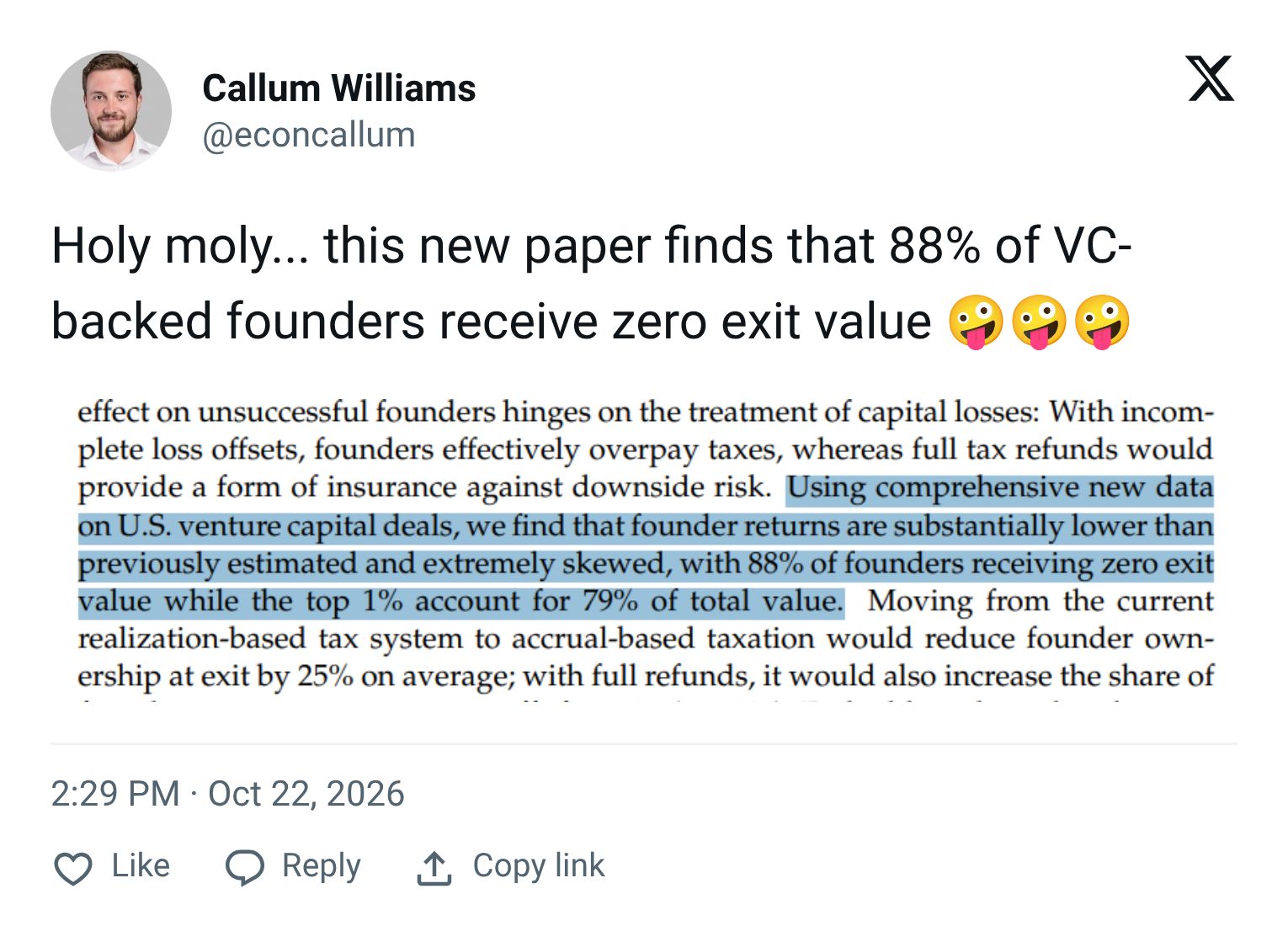
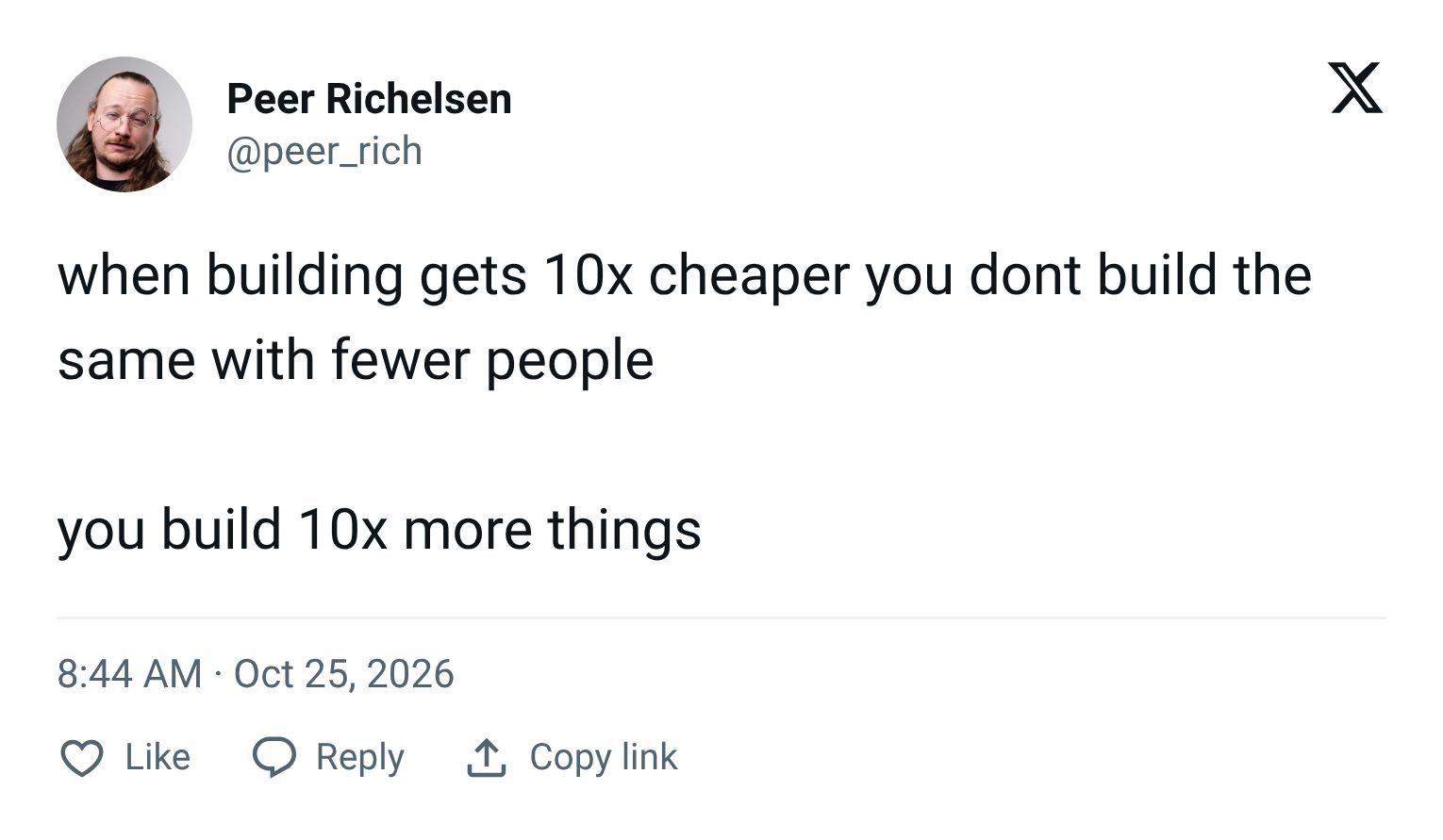
Here are the options I have for us to work together. If any of them are interesting to you - hit me up!
Sponsor this newsletter: Reach thousands of tech leaders
Upgrade your subscription: Read subscriber-only posts and get access to our community
Buy my NEW course: Buy my course on outbound sales
And that’s it from me. See you next week.

